evapRET is a heavy liquid that flattens a detached retina from below, turns into gas within days to support it from above, then diffuses out on its own. No second procedure. Nothing left behind.
A retinal detachment is a blinding emergency. To let the retina heal, the surgeon fills the eye with something that presses it back into place. There are three choices, and each one fails in a different direction.
Inferior detachments are the ones most likely to re-detach, and gas does little for them. Patients spend days in strict head positioning to compensate.
Any residual droplet is a retained foreign body that can migrate under the retina or inflame the eye. Retention is one of the most feared complications of its use.
Oil must be surgically removed later and carries its own long-term risks. It is often the fallback for the inferior detachments gas cannot treat.
evapRET enters the eye as a heavy liquid and leaves it as a gas. The phase change happens at body temperature, inside the eye, with no further intervention.
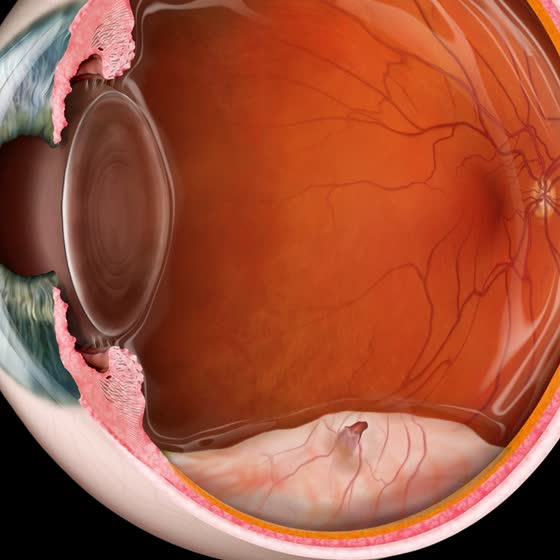
The retina has lifted at the bottom of the eye, where gas cannot reach.
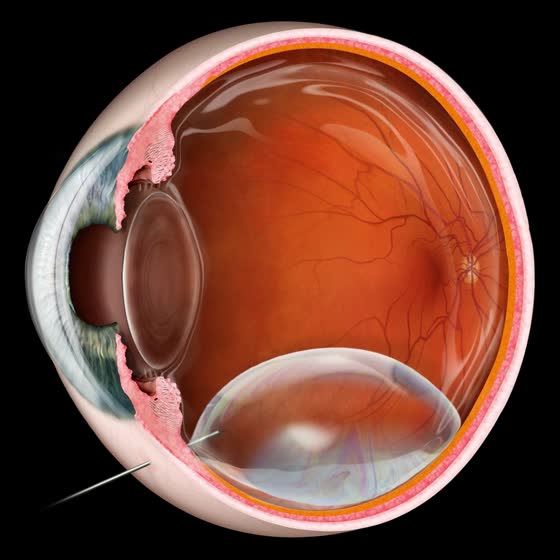
A small volume is injected. Being heavier than water, it settles on the detachment and flattens it.
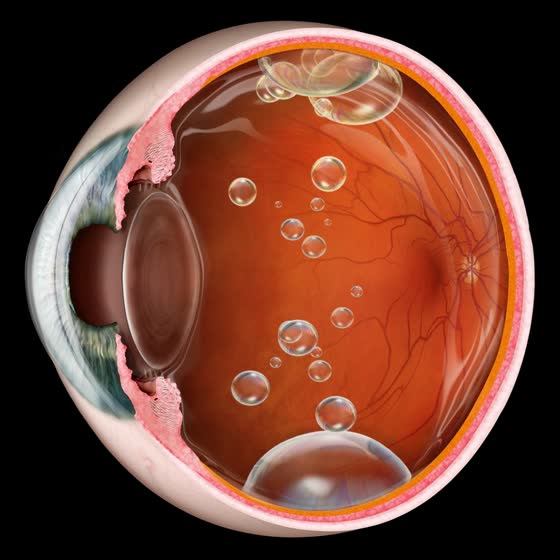
Over the following days the liquid vaporizes at body temperature, with no expansion step and no pressure spike.
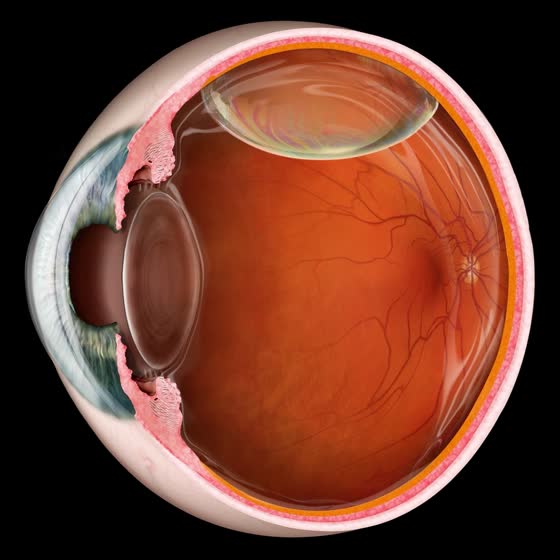
The resulting bubble rises and supports the superior retina, exactly as a conventional gas would.
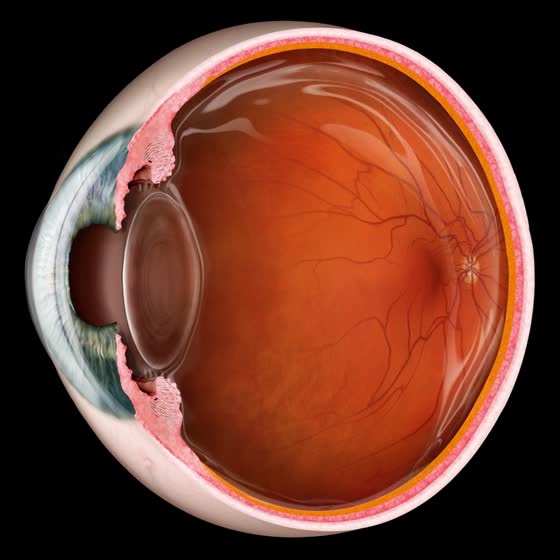
The gas diffuses out through the normal route. The retina stays attached. Nothing is left to remove.
evapRET is a volatile fluorinated ether: optically clear, denser than water, immiscible with aqueous, and designed to evaporate under intraocular conditions. FDA regulates it as a Class III medical device. It is manufactured to high purity by flow chemistry.
Two intended uses: as an intraoperative heavy liquid that can never be retained, because any residual simply evaporates; and as an in-clinic injection for inferior detachments, giving temporary inferior support where a gas pneumatic retinopexy cannot, and potentially avoiding the operating room altogether for a subset of patients.
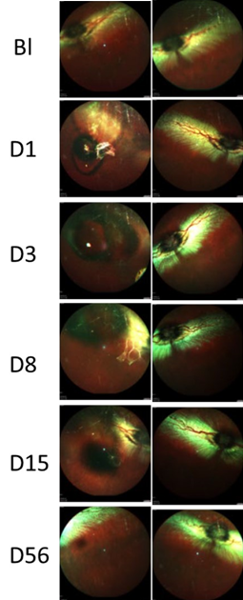
Dutch Belted rabbits, 8 microliters injected into one eye, balanced salt solution in the fellow eye. Followed with fundus photography, OCT, intraocular pressure and electroretinography through day 56.
Presented at the Retina Society (2023), ARVO (2024) and ASRS (2024).
Selected at the American Academy of Ophthalmology annual meeting; the company’s first non-dilutive award.
EyeWorld coverageAmerican Society of Retina Specialists annual meeting, Stockholm.
ASRS multimediaAssociation for Research in Vision and Ophthalmology annual meeting, published in IOVS.
ARVO abstractRetina Society 56th annual meeting, New York, covered by Modern Retina.
Modern RetinaFiled through Knobbe Martens from a 2023 US provisional and a 2024 PCT. National stage applications are active in the United States, Canada, the European Union, China and South Korea. The synthesis and purification route is held separately as know-how.
| International publication | WO 2024/215683 |
| PCT application | PCT/US2024/023759 |
| European Patent Office | EP24789321.7 (EP4676449) |
| China (CNIPA) | CN202480038120.2 |
| South Korea (KIPO) | KR10-2025-7037295 |
| United States, Canada | National stage, pending |
Avant Sciences, Inc. is a Delaware corporation founded in 2023.
evapRET is being developed as a Class III device. The near-term goal is FDA approval of an Early Feasibility Study under an Investigational Device Exemption.
Candidate evaporative heavy liquids identified and sourced; evaporation inside the eye demonstrated in vivo.
Avant Sciences incorporated in June 2023. Data presented at the New York Ophthalmologic Society and the Retina Society.
PCT application filed in March. First FDA pre-submission meeting in May. High-purity material in hand by July; GMP manufacturing route established by year end. ARVO and ASRS presentations. Eyecelerator award at AAO.
Angel financing from retina specialists, physicians and finance professionals with a history of early-stage investing. GMP purification, release and aseptic fill partners engaged.
Second FDA pre-submission meeting held July 2026 with CDRH’s retinal devices team. Admitted to CDL-Vancouver’s Biomedical Engineering stream. Formal evaporation characterization under way to set the large-animal dose.
Protocol reviewed by FDA before the study starts, per agency guidance. IDE for an Early Feasibility Study to follow.
An Early Feasibility Study in patients with inferior retinal detachment, where today’s options are weakest and where a tamponade that supports from below and then leaves on its own has the most to offer.
Four co-founders who have worked together for decades at the New York Eye and Ear Infirmary of Mount Sinai and the James J. Peters VA Medical Center. Two of them train the next generation of retina surgeons.
Trained at Bascom Palmer Eye Institute and completed vitreoretinal fellowship at Columbia under Stanley Chang, who brought the first purified heavy liquid to the retina field. His decade of work on evaporative tamponades is the basis of Avant’s pipeline. Degrees from Stanford University and Cornell University.
Has mentored more than fifty residents from Mount Sinai and NYEE and holds numerous teaching awards. A long-time angel investor in medical and non-medical startups. Residency and glaucoma fellowship at NYEE; MD, University of Chicago.
More than three decades in clinical and scientific retina, over 100 papers and chapters, and an international reputation in ophthalmic imaging and surgical devices. Has helped form and run several biotech startups.
Nearly three decades as a research specialist in ophthalmology at Cornell, Columbia and NYEE, managing federal, foundation and industry-sponsored studies, animal work and bench programs. Previously managed the Basic Science Course in Ophthalmology at Columbia.
We are raising to reach the IDE and are speaking with strategic partners, vitreoretinal surgeons interested in the Early Feasibility Study, and contract manufacturers and CROs.